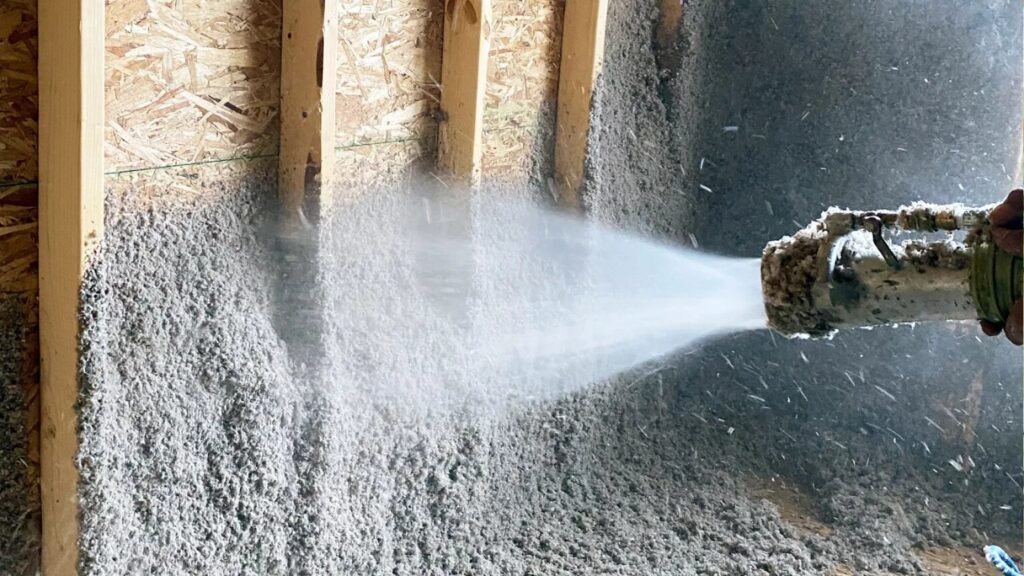
Dense-pack cellulose and standard loose-fill insulation may look similar at first glance—both are made from recycled paper, primarily newsprint—but their performance, application method, and long-term behavior in walls and attics differ significantly. Homeowners and commercial property managers often ask: is dense-pack worth the extra effort? How does it compare in air control, moisture resistance, or thermal consistency?
This guide breaks down the key differences, practical benefits, and real-world performance of each option. It helps clarify which product suits which scenario—and why those differences matter.
How Dense-Pack Cellulose Works Differently from Loose-Fill
Dense-pack cellulose insulation is not just a denser version of loose-fill—it behaves differently under pressure, controls airflow better, and serves distinct purposes in wall assemblies.
Dense-Pack Cellulose: Compression Improves Air Control
Dense-pack cellulose is installed using higher pressure to compress the material into wall cavities or enclosed spaces. It typically reaches a density of 3.5 to 4.0 pounds per cubic foot (pcf), which is enough to prevent settling and stop air movement through the material.
This matters because controlling airflow through insulation increases thermal consistency and limits moisture-driven mold risks.
Loose-Fill Cellulose: Suitable for Open Attic Spaces
Loose-fill cellulose is blown in with low pressure and minimal compaction—around 1.5 to 2.0 pcf. It’s ideal for open, horizontal spaces like attic floors where full coverage is more important than air sealing.
In these open spaces, loose-fill provides good thermal performance, but it won’t stop uncontrolled air movement or resist moisture-laden air infiltration without additional sealing measures.
R-Value and Thermal Performance Differences
Both forms of cellulose provide a high R-value per inch, but the difference in installation method changes the performance over time and under real-world conditions.
Dense-Pack Offers Consistent R-Value Over Time
Because dense-pack resists settling and prevents air intrusion, it maintains its stated R-value more reliably. Settling is minimal, and insulation stays where it’s placed. This makes it more suitable for vertical wall cavities, cathedral ceilings, and enclosed assemblies.
Loose-Fill May Require More Depth to Achieve the Same Performance
In attic floors or other open areas, achieving the same R-value often means using more product (inches of depth) since air leakage and slight settling can reduce performance unless sealed or topped up periodically.
Comparison Table: Dense-Pack vs Loose-Fill
|
Feature |
Dense-Pack Cellulose |
Loose-Fill Cellulose |
|---|---|---|
|
Installation Method |
Dense compression (3.5–4.0 pcf) |
Loose blow (1.5–2.0 pcf) |
|
Air Control |
Excellent |
Limited unless sealed |
|
Settling Over Time |
Minimal |
Moderate |
|
Best Used In |
Walls, sloped ceilings |
Open attic floors |
|
Moisture Resistance |
Better due to density |
Less effective |
|
Thermal Bridging Control |
High |
Medium |
Application Areas: When to Use Each Type
Where the insulation goes determines how effective it is. Selecting the wrong product for the application reduces efficiency, increases maintenance, and compromises comfort.
Dense-Pack for Enclosed Cavities
Use dense-pack in:
- Exterior wall retrofits or new walls
- Cathedral ceilings
- Knee wall spaces
- Enclosed floor assemblies
It fills every void, adds slight resistance to sound transmission, and acts as a secondary air barrier.
Loose-Fill for Horizontal Surfaces
Use loose-fill in:
- Open attic floors
- Floor decks over unheated basements
- Low-cost insulation upgrades
It’s easier to install and cost-effective for large open areas where access is straightforward and airflow isn’t a major issue.
Air Sealing and Moisture Management Capabilities
Dense-pack and loose-fill differ in how they deal with air and moisture—two of the biggest factors in insulation effectiveness over time.
Dense-Pack Controls Unintended Air Movement
Dense-pack cellulose limits airflow through framing cavities, which reduces:
- Heat loss from air leakage
- Moisture transfer from inside to outside walls
- Mold potential from condensation
For buildings in climates with high temperature swings or humidity, this adds a layer of resilience.
Loose-Fill Needs Complementary Air Sealing
Loose-fill insulation allows more convective looping—air movement within the insulation—especially if attic hatches, can lights, or drywall seams leak air. Air sealing should be done before blowing in loose-fill to maintain performance.
Installation Process Differences
How each type is installed influences cost, required equipment, and disruption.
Dense-Pack Requires More Time and Equipment
Installers use specialized blowing machines and netting or drill-and-fill techniques to pack cellulose into cavities. It takes more time and skill but ensures complete coverage and long-term reliability in wall systems.
Loose-Fill Is Faster and Requires Less Labor
Loose-fill insulation can be installed using a rental blower for simple attic jobs. It’s less invasive and more DIY-friendly, though results vary with experience.
Conclusion
Dense-pack cellulose differs from standard loose-fill in more than just density. It offers better air control, long-term thermal consistency, and resistance to moisture-driven problems. This makes it ideal for enclosed wall cavities and building assemblies where airflow must be controlled.
Loose-fill works well in open spaces like attic floors where speed and cost are priorities, and where complementary air sealing can help offset its lower air resistance.
Choosing between the two should depend on the building structure, insulation goals, and long-term energy performance expectations—not just upfront cost or ease of installation.
FAQs
What’s the main reason to use dense-pack instead of loose-fill?
Dense-pack provides air resistance in addition to thermal performance, making it more effective in walls, ceilings, and other enclosed assemblies where air leakage needs to be minimized.
Does dense-pack cellulose settle over time like loose-fill?
No. Properly installed dense-pack insulation is compressed to a point where settling is virtually eliminated, unlike loose-fill, which can shift and compress over time.
Can dense-pack be installed in attics?
Only if the attic is enclosed or framed in a way that allows for dense packing. For open attic floors, loose-fill is the more appropriate choice.
Is there a difference in fire resistance between the two?
Both types of cellulose insulation are treated with the same fire-retardant additives. Fire resistance is similar, assuming installation is to code.
Which insulation is better for sound control?
Dense-pack cellulose has higher density and fills cavities more completely, so it provides better sound-dampening performance compared to loose-fill in most wall applications.
Author: With over two decades of hands-on experience, Robert Lamothe, owner and lead installer of Lamothe Insulation, brings unparalleled expertise in spray foam insulation, carpentry, and building science. Since 2002, he has earned a reputation for precision, quality craftsmanship, and delivering energy-efficient solutions that stand the test of time. Lamothe Insulation is a family-owned and family-operated business, and Robert also owns the Goddard School of Auburn, an early childhood education school.
Reviewer: Ethan Taylor has 8 years of experience in spray foam insulation. He reviewed this content and suggested ways to simplify business outreach while keeping trust and professionalism intact.