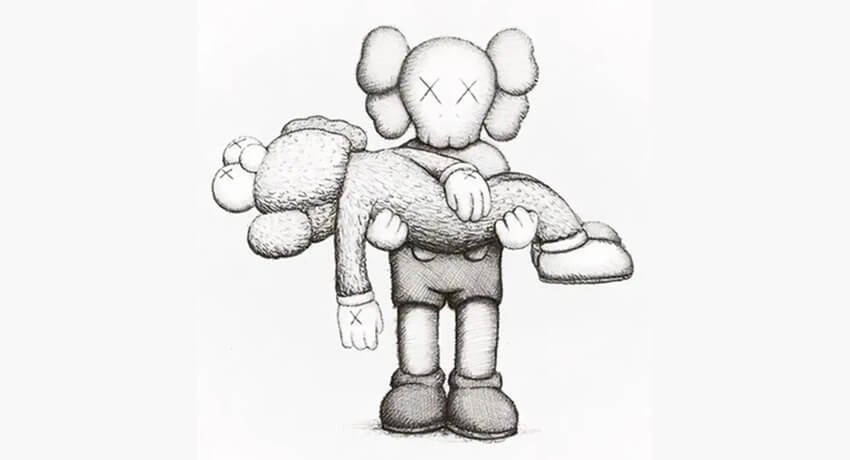
KAWS drawing refers to the distinctive drawing style developed by KAWS, whose real name is Brian Donnelly. He is a world-famous contemporary artist known for blending fine art, street art, graphic design, and pop culture. KAWS drawings are immediately recognizable because of their bold outlines, simplified cartoon forms, expressive body language, and the iconic “X” marks used for eyes. Over the past two decades, KAWS drawings have become extremely popular among art students, beginners, street artists, and even casual hobbyists. One of the most common questions people ask is why KAWS drawings are considered easy to draw compared to many other art styles. To understand this fully, it is important to explore what KAWS drawing actually is, where it comes from, what visual elements define it, and why those elements make the style accessible to so many people.
At its core, KAWS drawing is a modern reinterpretation of cartoon imagery. Brian Donnelly began his career as a graffiti artist in the streets of New York City, where speed, clarity, and visual impact were essential. Graffiti artists must communicate ideas quickly and clearly, often working under pressure. This environment naturally influenced KAWS’s drawing style. His early work involved altering existing advertisements, such as posters at bus stops or phone booths, by adding his signature characters and symbols. Over time, this practice evolved into a unique visual language. KAWS drawings are not meant to be overly realistic or technically complex; instead, they focus on strong shapes, emotional resonance, and instantly recognizable features. This approach makes the drawings easy to understand and easy to recreate, even for people with limited drawing experience.
One of the most defining features of KAWS drawing is the use of cartoon-like characters. These characters often resemble familiar figures from popular culture, such as animated characters or mascots, but they are reimagined through KAWS’s own artistic lens. The most famous of these is the “Companion” figure, which looks like a simplified cartoon character with a skull-shaped head and crossed-out eyes. Because these characters are based on cartoons rather than real human anatomy, they avoid the complexities of realistic proportion, shading, and detail. Cartoons are designed to be simplified representations of reality, and KAWS builds upon that tradition. This simplification is a major reason why his drawings feel approachable to beginners.
Another key aspect of KAWS drawing is the emphasis on basic geometric shapes. Heads are often circular or oval, bodies are composed of cylinders or simple blocks, and limbs are drawn using smooth, rounded lines. These shapes are some of the first forms taught in beginner art classes because they are easy to control and combine. When drawing in the KAWS style, artists do not need to master advanced anatomy or perspective. Instead, they can focus on assembling simple shapes into a recognizable figure. This reduces the intimidation factor that many people feel when starting to draw and makes the style ideal for practice and experimentation.
The line quality in KAWS drawing also contributes to its accessibility. KAWS uses bold, clean outlines that clearly define the edges of his figures. These outlines are not overly detailed or textured; they are smooth and confident. For beginners, this is encouraging because it removes the pressure to create perfect shading or realistic textures. A strong outline can carry the entire drawing. Even if the interior details are minimal, the drawing still looks complete. This approach teaches an important lesson: clarity is often more powerful than complexity. As a result, many people find that their drawings look “good” very quickly when they adopt this style, which boosts confidence and motivation.
Color usage in KAWS drawing is another reason it feels easy to replicate. KAWS often uses flat, solid colors rather than complex gradients or realistic lighting. These colors are usually bold and carefully chosen to create contrast and visual impact. Flat coloring is much easier than realistic shading because it does not require deep knowledge of light sources, reflections, or shadow transitions. For beginners, simply filling in areas with solid color already produces a polished result. Even when working in black and white, KAWS drawings remain strong because the underlying shapes and outlines are doing most of the work.
The iconic “X” eyes are perhaps the most recognizable feature of KAWS drawing. These crossed-out eyes replace the need to draw realistic facial expressions. Human faces are notoriously difficult to draw because even small mistakes can make a face look unnatural. By using simple “X” shapes for eyes, KAWS eliminates this challenge entirely. The mouth is often minimal or absent, and the expression is conveyed more through posture and body language than facial detail. This design choice not only creates a strong brand identity but also makes the drawings far easier to reproduce accurately.
Emotion plays a significant role in KAWS drawing, despite the simplicity of the forms. The characters often appear sad, tired, introspective, or withdrawn. This emotional depth is achieved not through detailed facial features but through pose, gesture, and composition. For example, a character covering its face with its hands or slouching its shoulders can express vulnerability or sadness. This teaches artists that emotion does not always require complex detail. Even simple shapes can communicate powerful feelings. Because of this, beginners can focus on storytelling and expression rather than technical perfection.
Another reason KAWS drawing is considered easy is its strong reliance on repetition and consistency. Once you learn how to draw one KAWS-style character, you can easily draw many variations. The same head shape, eye style, and body structure can be reused with small changes in pose, size, or accessories. This repetition helps artists build muscle memory and confidence. Over time, drawing becomes faster and more intuitive. Many beginners struggle with constantly trying to invent new forms, but KAWS’s style encourages working within a familiar framework, which reduces creative pressure.
The influence of pop culture also makes KAWS drawing accessible. Many of his works reference familiar cartoons, toys, and characters that people already recognize. When artists draw something that feels familiar, it becomes less intimidating. They are not starting from nothing; they are adapting something they already understand visually. This familiarity makes the learning process smoother and more enjoyable. It also explains why KAWS drawings are popular on social media platforms, where people share fan art and personal interpretations of his characters.
From an educational perspective, KAWS drawing is an excellent entry point into contemporary art. It teaches fundamental skills such as shape construction, line control, composition, and visual storytelling without overwhelming the learner. Because the results look visually appealing even at a basic skill level, students are more likely to continue practicing. This positive feedback loop is crucial for developing long-term artistic ability. Many professional artists actually recommend starting with simplified styles like KAWS’s before moving on to more complex realism.
The accessibility of KAWS drawing is also connected to the tools required. You do not need expensive materials to draw in this style. A pencil, pen, or digital drawing tablet is enough. The style translates well across different mediums, including sketchbooks, murals, sculptures, and digital illustrations. This flexibility makes it easy for people from different backgrounds and economic situations to participate. In contrast, some art styles require specialized tools or years of training to achieve acceptable results.
KAWS drawing is also easy to learn because there is a wealth of visual reference material available. Since KAWS is a globally recognized artist, images of his work are widely shared in books, exhibitions, and online platforms. Beginners can study these references to understand proportions, shapes, and composition. Visual learning is often more effective than theoretical instruction, and KAWS’s clear, consistent style makes it especially suitable for this kind of study.
Another important factor is that KAWS drawing does not demand perfection. Slight imperfections in line or proportion often add character rather than detract from the work. This is very different from hyper-realistic drawing, where even small mistakes are obvious. The forgiving nature of the style reduces fear of failure, which is one of the biggest obstacles for beginners. When people feel safe to make mistakes, they are more willing to experiment and improve.
Culturally, KAWS drawing represents a shift in how we define “high art.” By blending street art, cartoons, and commercial design, KAWS challenged traditional boundaries between fine art and popular culture. This inclusivity is reflected in the accessibility of his drawing style. It sends the message that art does not have to be complex or elitist to be meaningful. This philosophy resonates with many people, especially younger generations, who value authenticity and emotional connection over technical showmanship.
In conclusion, KAWS drawing is easy to draw not because it lacks depth or artistic value, but because it is built on simplicity, clarity, and emotional honesty. Its reliance on basic shapes, bold outlines, flat colors, and iconic symbols removes many of the technical barriers that intimidate beginners. At the same time, it offers enough expressive potential to keep experienced artists interested. KAWS drawing proves that powerful art does not need to be complicated. By focusing on strong ideas, recognizable forms, and emotional storytelling, it creates a style that is both approachable and meaningful. This balance is the reason why KAWS drawing has become so popular worldwide and why so many people find joy and confidence in drawing it.