Agriculture has reached a new era in which data, automation, and smart technologies are transforming the approach to growing crops. The root of this revolution is the Smart Agriculture System, a group of technologies that work towards making all aspects of farming optimal. Its biggest contribution is towards enhancing the way we monitor crops—arming farmers globally with a degree of precision, efficiency, and real-time information never before achieved.
The Issue with Traditional Crop Monitoring
Traditional methods of crop monitoring by farmers have relied on visual observation, farm visits, and manual data recording. Although these practices are quite effective, they require significant labor, consume a lot of time, and are susceptible to human mistakes. Seasonal weather conditions, insect infestation, and soil heterogeneity introduce uncertainties that are difficult to address with traditional tools.
This is where technology enters the scene—not as luxury but as a necessity.
Real-Time Data and Remote Sensing
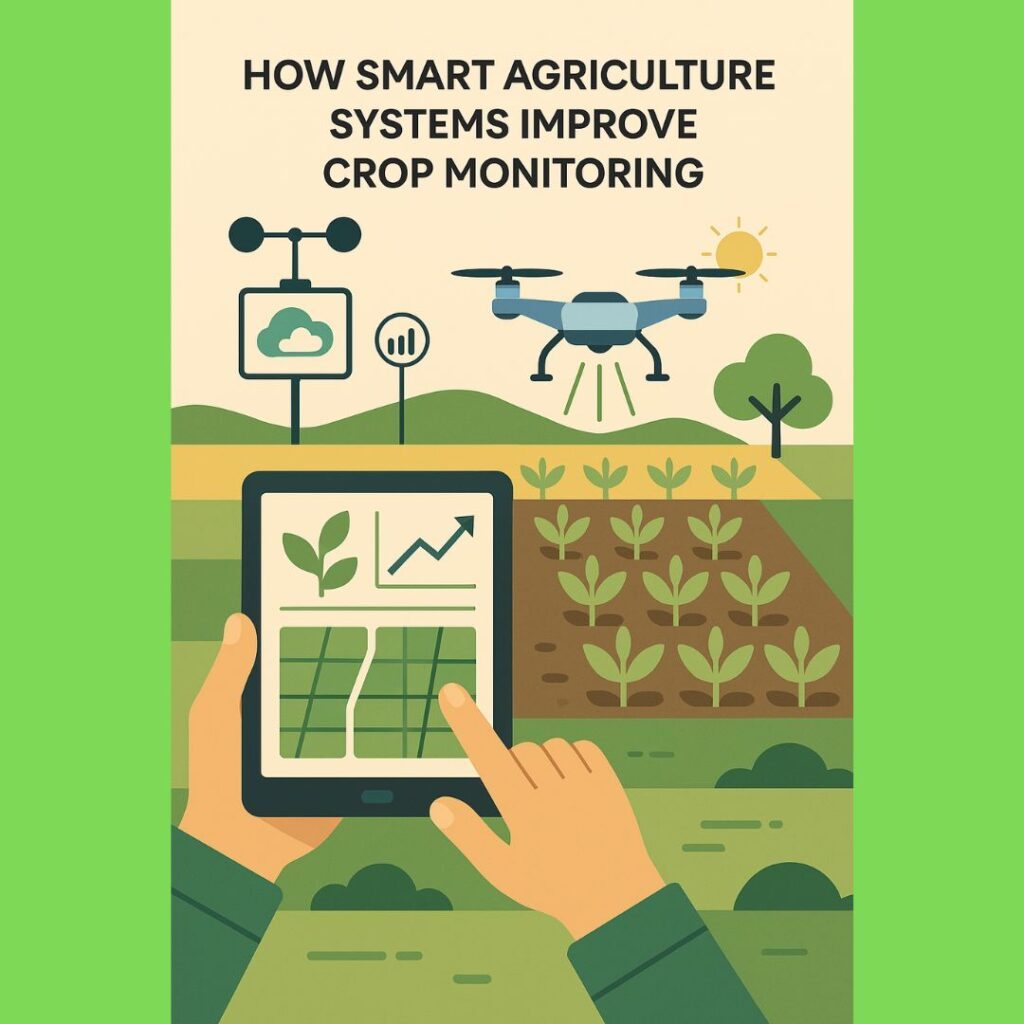
Smart farm technology utilizes a combination of weather stations, satellites, drones, and sensors to provide real-time data about the health of the plants, nutrient levels, soil moisture levels, temperature, etc. The equipment can receive proper information without the farmer’s physical presence in the field.
For example, soil sensors for water can quantify water levels in different parts of a field to be able to irrigate area-wise. Multispectral cameras can be fitted on drones that detect disease or nutrient stress even beyond human vision. All such inputs are utilized for prompt and practical action, which reduces loss and improves yield.
Predictive Analytics and AI
One of the most exciting elements of modern farming systems is the intersection of predictive analytics and artificial intelligence. These tools browse vast amounts of data that have been gathered from the field and render it into actionable data. Farmers can now anticipate issues before they occur—such as being able to predict a fungal infestation with increased humidity or schedule planting calendars based on weather predictions.
This predictive capacity leads to less surprise in the growing season and greater management of the growth of the crops. The ultimate outcome is not only increased output but also reduced costs because of efficient utilization of resources like fertilizers, pesticides, and water.
Improved Decision Making through Centralized Platforms
Some of the solutions in smart farming offer a central in nature dashboard where farmers are able to compare, analyze, and see data for several fields and parameters. Such a holistic picture aids more holistic decisions with holistic information and not gut feeling.
For instance, if a section of a farm is consistently reporting below-average output, historical records can be employed to identify the cause—whether due to poor soil, inefficient irrigation, or pest attack. The farmer can then implement targeted remedies to correct the problem, improving output without needing to test and fail.
Sustainability Through Efficiency
Sustainability is as important today as productivity. Intelligent farming is necessary to reduce the environmental footprint of farming. Autonomous platforms ensure water, fertilizers, and pesticides are used only where and when needed. Precision prevents waste, avoids runoff into neighboring waterways, and maintains vital ecosystems.
Apart from that, by enabling better planning and reducing crop loss, smart systems assist in ensuring more stable food supply, which is extremely vital in maintaining the world’s rapidly increasing population in check without depleting the resources of our world.
Accessibility and Scalability
Unlike what many people think, intelligent farming does not have to be for the big farms. The technology itself can be scalable so that small and medium farms can also utilize it. Many of the solutions are modular and phased innovations can occur incrementally such that the farmer can begin in small ways—perhaps with a soil sensor or drone imagery—and expand out as benefits become self-apparent.
Mobile apps, cloud platforms, and affordable IoT devices are increasingly accessible to farmers even in rural areas to take advantage of smart farming.
The Future of Crop Monitoring
With each day that passes, technology is moving a step forward, and thus more advanced tools will be developed. The machine learning algorithms will be more accurate, remote sensing more targeted, and the integration with global climate models will enable long-term planning.
On a bridge of established know-how and new innovation, smart systems are building foundations for a completely new kind of agriculture—one in which productivity and sustainability are the partner of precision.
Finally, Smart Technology-driven Crop Monitoring Systems are not machinery—they are revolutionaries, delivering farmers with understanding and command they require to achieve in a globe that is developing at breakneck speed.