In the electrical and cable industry, compliance is the bedrock of trust. A cable manufactured in one country must be guaranteed to meet the rigorous safety and performance standards of any market in which it is installed, whether that’s a high-speed metro in India or a critical infrastructure project in Europe. For a global leader like Ducab, ensuring this compliance is a massive undertaking that requires not just adherence to rules, but a proactive, continuous commitment to quality assurance that transcends national boundaries.
The Global Compliance Framework
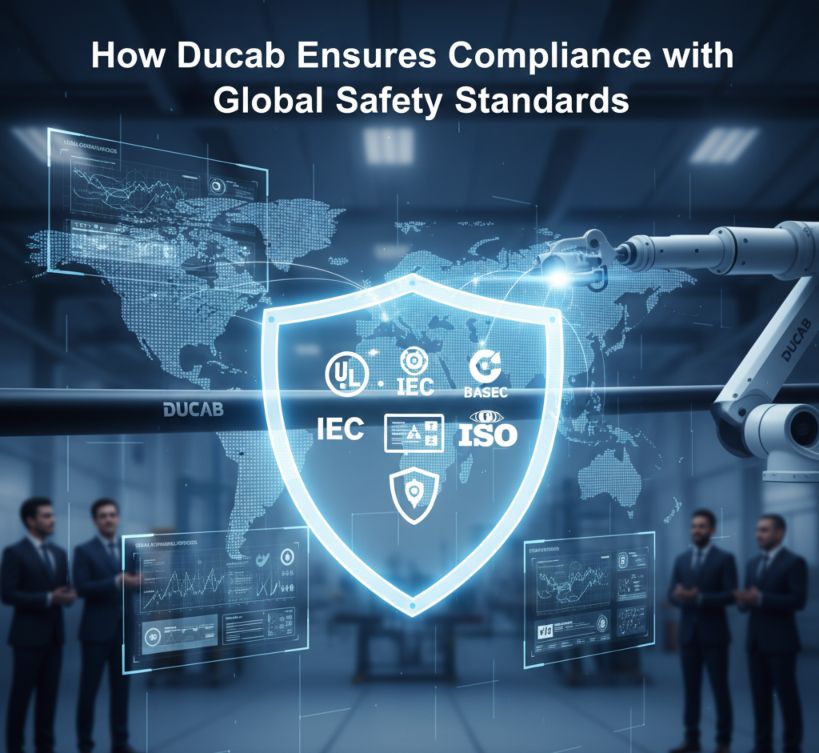
Ducab operates within a framework of the world’s most stringent regulatory bodies. Compliance means not just meeting local $text{GCC}$ standards but conforming to the mandates of major international bodies:
- IEC (International Electrotechnical Commission): The foundational global standard for all electrical, electronic, and related technologies, defining everything from cable construction to testing methods.
- BASEC (British Approvals Service for Cables): One of the most respected independent certification bodies globally, BASEC approval is a mark of consistent, high-quality manufacturing and rigorous testing.
- UL (Underwriters Laboratories): A critical U.S.-based certification, often required for North American projects, covering fire safety and product performance.
- BS (British Standards): Often used alongside $text{IEC}$ in various markets, particularly for fire safety (e.g., $text{BS } 6387$ for fire resistance).
Pillar 1: Meticulous Testing and Certification
Compliance is verified through continuous, rigorous testing performed both internally and by external third parties.
- Fire Performance Testing: Cables destined for public and critical infrastructure must undergo simulated fire tests. $text{LSZH}$ cables are tested to ensure they meet the lowest thresholds for smoke opacity and corrosive gas emission ($text{IEC } 61034$, $text{IEC } 60754$). Fire-resistant cables are tested under direct flame and mechanical shock ($text{IEC } 60331$) to guarantee circuit integrity.
- Partial Discharge ($text{PD}$) Testing: For high-voltage cables, $text{PD}$ testing is essential to guarantee insulation integrity, verifying that no microscopic voids or contaminants exist that could lead to premature failure.
- Third-Party Audits: Ducab’s manufacturing facilities are routinely subjected to stringent, unannounced inspections and audits by bodies like $text{BASEC}$ and $text{UL}$. These audits verify not only the final product but the consistency of the entire manufacturing process and quality system.
Pillar 2: Supply Chain Integrity
A cable’s compliance starts with its raw materials. Ducab enforces strict quality checks on every incoming material stream.
- Conductor Purity: $text{QC}$ verifies the purity and conductivity of copper and aluminum to ensure the cable meets its rated ampacity without excessive heating.
- Polymer Consistency: Specialized $text{LSZH}$ and $text{XLPE}$ compounds are tested batch-by-batch for consistency in density, thermal properties, and fire behavior. This reliance on high-standard materials is guaranteed by strong relationships with partners, such as quality cable suppliers in uae.
- Traceability: Every product leaving the factory floor is fully traceable back to its original raw material batch and production date, ensuring accountability and compliance checks at any point during the cable’s lifespan.
Pillar 3: Engineering the Future of Standards
Ducab doesn’t just react to standards; as a leader, the company often drives innovation that sets new standards. For instance, in supporting the $text{UAE}$’s energy goals and critical infrastructure, cable manufacturers in uae must often engineer products to custom project specifications that exceed international norms. This proactive approach ensures their products are not just compliant today but are future-proofed for the infrastructure demands of tomorrow.
Conclusion: Trust is Built on Testing
For Ducab, ensuring compliance with global safety standards is the foundation of its business. It is a commitment upheld through continuous, meticulous testing, strict supply chain verification, and a culture of quality assurance. This guarantees that whether a cable is powering a smart grid in the Middle East or a transit system in Asia, it delivers the highest level of safety, reliability, and performance expected by the world’s most demanding customers.
Your Global Compliance Questions Answered (FAQs)
- What does the IEC standard define regarding cables?
The $text{IEC}$ defines global standards for electrical products, including cable testing methods ($text{IEC } 60331$ fire resistance), insulation materials, voltage ratings, and dimensions, aiming for international uniformity. - Why is BASEC approval important for a cable manufacturer?
$text{BASEC}$ provides independent, third-party certification and conducts unannounced audits. $text{BASEC}$ approval signifies that the manufacturer consistently produces cables that meet strict international quality and safety benchmarks, giving customers confidence in the product’s reliability. - How do standards bodies verify the safety of fire-resistant cables?
They test the cables under fire and mechanical stress. For example, $text{IEC } 60331$ requires the cable to remain energized and functional while exposed to direct flame and shaking for a specific time, ensuring circuit integrity during a fire. - What is the UL standard primarily known for in cables?
$text{UL}$ (Underwriters Laboratories) is highly recognized for its safety certifications in North America, particularly its standards for fire resistance, flammability, and the overall safety of electrical components. - How does cable compliance affect international trade?
Compliance is often a legal barrier to entry. If a cable lacks the required $text{CE}$, $text{IEC}$, or $text{UL}$ mark for a specific market, it cannot be legally installed there. Compliance ensures market access and speeds up project approvals.