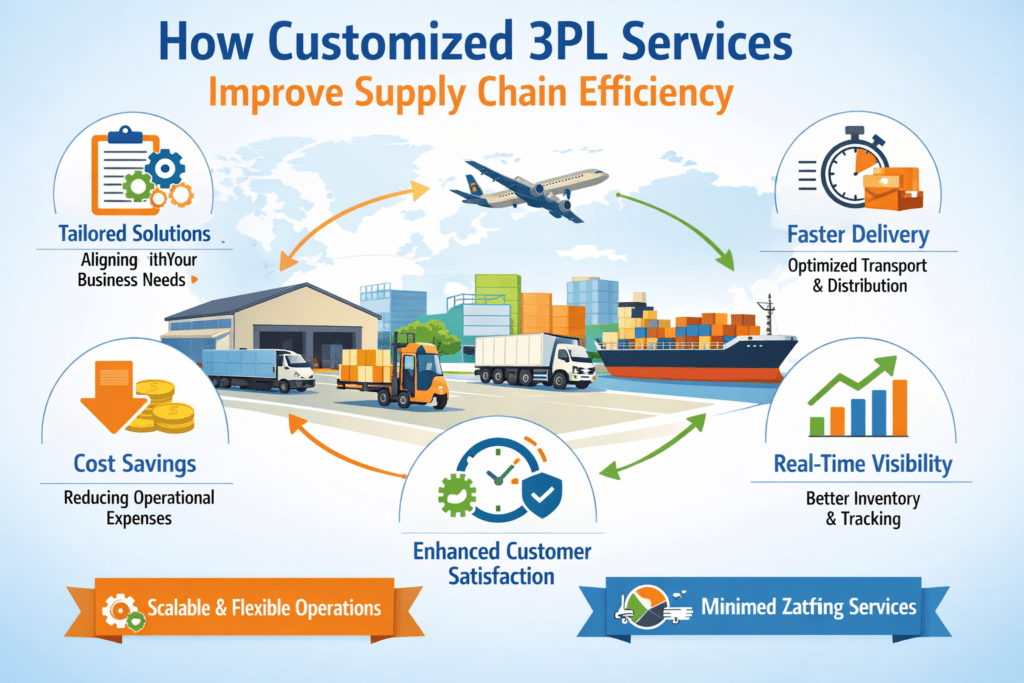
In most Indian organisations, supply chains are built incrementally. Processes are added as volumes increase; warehouses get added when space runs out, and routes are improved based on short-term needs rather than long-term design. Over time, this builds systems that work, but only just. Delays are routine, coordination happens only because of follow-up, and efficiency is very dependent on individual effort. This is where customised 3PL services make a difference. Rather than use standard operating models, a customised approach redesigns logistics around how a business really works, introducing order, clarity, and discipline in routine supply chain activities.
Customisation is not overengineering operations. It is about creating logistic processes that fit the business, not forcing the business to fit a generic model for logistics.
What Customised 3PL Services Really Entail?
A third-party logistics service provider offering customised services begins with an understanding of the client’s operational reality. This relates to product behavior, the frequency of orders, warehouse constraints, road movement patterns, and internal decision-making structures.
In place of a pre-defined suite of services, customised 3PL solutions could include:
- Warehousing processes are organised based on the frequency of movement instead of product categories.
- Road dispatch plans based on real delivery density
- Inventory reporting aligned with internal review cycles
- Workforce planning adapted to predictable volume fluctuations
This level of tailoring permits logistics management to become an integrated support function rather than an independent operational task.
The Limitations of Standard Logistics Models
Standard logistics models are designed for ease of replication, not operational nuance. While they may function quite well at smaller scales, problems often surface as operations expand.
Common challenges include:
- Congestion within warehouses during high-volume periods
- Poor coordination between storage and dispatch teams.
- Poor visibility into inventory movement
- Reactive decision-making based on everyday stresses
In such environments, supply chain management becomes about resolving issues instead of preventing them. Customised 3PL services address these limitations directly by building flexibility into the system.
Strengthening Logistics Management Through Practical Design
Effective logistics management depends on clarity. When processes are designed around actual workflows, teams spend less time coordinating and more time executing.
A customised 3PL framework typically improves:
- Storage discipline by reducing unnecessary internal movement
- Dispatch accuracy through structured scheduling
- Documentation flow, making information easier to track
- Accountability by clearly defining responsibilities
These changes may seem incremental, but collectively, they create a system that is easier to manage and scale.
How to Gain Better Control Across the Supply Chain?
Focus on the Right Control Points
Supply chain management improves when control is applied at the right stages of the process. Customised 3PL services help identify where intervention is most effective.
Key control areas often include:
- Inbound planning: Ensuring arrivals match warehouse capacity
- Storage management: Structuring zones to reduce handling time
- Dispatch coordination: Sequencing loads to avoid congestion
- Performance monitoring: Tracking metrics that reflect operational reality
By strengthening these points, businesses gain predictability without adding complexity.
Reducing Day-to-Day Friction in Operations
One of the most noticeable benefits of customisation is the reduction of operational friction. When processes are designed specifically for the business, fewer exceptions arise.
This results in:
- Smoother handovers between teams
- Clearer communication channels
- Reduced dependency on constant follow-ups
- Faster resolution when issues occur
Instead of firefighting, teams are able to focus on maintaining consistency.
Supporting Growth Without Disrupting Existing Systems
Growth often exposes weaknesses in logistics setups. What works at one scale may struggle at the next. Customised 3PL services allow businesses to expand without destabilising daily operations.
This is achieved through:
- Gradual adjustment of warehouse capacity
- Flexible manpower planning
- Road movement schedules aligned with demand
- Reporting structures that evolve with management needs
Such adaptability ensures that growth is supported, not hindered, by logistics.
Improving Collaboration Between Business and Logistics Teams
Alignment Built on Understanding
When a third-party logistics provider operates on a customised model, collaboration improves naturally. Processes are designed around shared objectives rather than generic targets.
This alignment leads to:
- Clearer accountability
- Fewer misunderstandings during peak periods
- More productive planning discussions
- A shared view of performance expectations
Logistics becomes a partnership rather than a transactional service.
Consistency as the Real Measure of Efficiency
Speed is important, but consistency often delivers greater long-term value. Customised 3PL services focus on creating repeatable outcomes.
Businesses benefit from:
- Predictable delivery timelines
- Stable warehouse operations
- Reliable reporting
- Fewer unexpected disruptions
This consistency strengthens supply chain management by making performance dependable and measurable.
Better Visibility Leads to Better Decisions
Customised 3PL solutions often include reporting systems designed around how decisions are actually made. Instead of generic dashboards, information is presented in a way that highlights trends and risks.
This visibility supports:
- Early identification of bottlenecks
- Smarter resource allocation
- More accurate planning cycles
- Timely corrective action
With clearer insights, logistics management shifts from reactive to proactive.
Final Thoughts
Customised 3PL services are not about adding complexity or introducing unnecessary processes. They are about creating systems that reflect how a business operates daily. When logistics management is aligned with real operational needs, efficiency becomes sustainable rather than temporary.
This is where experienced providers with a deep understanding of Indian road-based logistics stand out. Organisations such as Varuna Group illustrate how tailored 3PL services can strengthen supply chain management through disciplined execution, adaptable structures, and close collaboration. When logistics is customised around the business, it stops being a constant challenge and becomes a reliable foundation for long-term efficiency and growth.