For years, CRM platforms were treated as static systems—install once, customize a little, and force teams to adapt around them. But global businesses today operate in a radically different environment. Customer journeys are dynamic, channels change rapidly, and technology stacks evolve every quarter.
This shift is driving a major transformation in CRM development services: the move from monolithic CRM platforms to composable CRM architecture.
Composable CRM is not a buzzword. It’s a fundamental change in how CRM systems are designed, built, and scaled—placing flexibility, modularity, and integration at the core of customer relationship management.
Why Traditional CRM Systems Are No Longer Enough
Legacy CRM systems were built as all-in-one solutions. Sales, marketing, support, analytics, and integrations were tightly coupled inside a single platform. While this worked in the past, it now creates serious limitations:
- Slow customization and upgrades
- High dependency on vendors
- Poor scalability across regions and teams
- Difficulty integrating with modern tools
- Growing technical debt
As businesses expand globally and adopt cloud-first strategies, these rigid platforms struggle to keep pace. This is where CRM modernization becomes essential—and composable architecture emerges as the answer.
What Is Composable CRM Architecture?
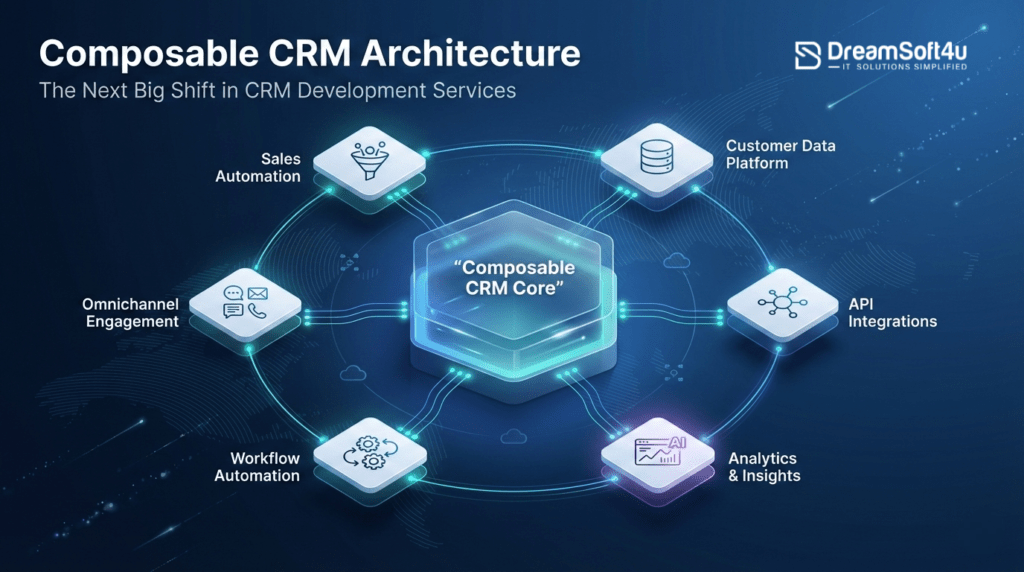
Composable CRM architecture is a modular approach to CRM design. Instead of relying on a single, tightly integrated system, businesses build CRM platforms using independent, interchangeable components.
Each CRM function—such as customer data management, workflow automation, analytics, or communication—exists as a separate service that can be developed, replaced, or scaled independently.
In simple terms:
A composable CRM lets businesses assemble exactly what they need, when they need it.
This approach aligns perfectly with modern CRM software development, where agility and adaptability matter more than bundled features.
How Composable Architecture Is Reshaping CRM Development Services
Modern CRM development services are no longer focused on configuring pre-built tools. Instead, they emphasize architecture, integration, and long-term scalability.
Composable CRM development typically includes:
- API-first CRM design for seamless data exchange
- Microservices architecture to isolate features
- Cloud-based CRM development for global scalability
- Headless CRM frontends for flexible user experiences
This architectural shift allows businesses to innovate faster without disrupting existing operations.
Core Building Blocks of a Composable CRM
A well-designed composable CRM is built from multiple layers, each serving a distinct role.
1. Modular Backend Services
Each CRM function—lead management, customer profiles, automation, reporting—runs as an independent service. This enables faster updates and reduces system-wide failures.
2. API & Integration Layer
APIs connect the CRM with marketing platforms, ERP systems, analytics tools, and third-party applications. Strong CRM integration services are critical here.
3. Headless Frontend
A headless CRM separates the user interface from the backend, allowing businesses to deliver consistent experiences across web, mobile, and internal dashboards.
4. Data & Analytics Layer
Customer data flows into centralized analytics engines, supporting personalization, forecasting, and decision-making.
Together, these layers form a flexible CRM architecture that evolves with business needs.
Why Global Enterprises Are Adopting Composable CRM Development
Across industries, enterprises are moving toward composable CRM for strategic reasons—not just technical ones.
1. Faster Innovation
Teams can add or replace CRM components without rebuilding the entire system.
2. Scalability Across Regions
Composable systems support region-specific workflows, languages, and compliance requirements.
3. Reduced Vendor Lock-In
Businesses are no longer dependent on a single CRM vendor’s roadmap.
4. Lower Long-Term Costs
By avoiding unnecessary features, companies reduce licensing and maintenance overhead.
This makes composable CRM especially attractive for enterprise CRM solutions operating at scale.
Composable CRM vs Traditional CRM: A Strategic Comparison (Without Table)
Traditional CRM platforms are designed around completeness. They bundle sales, marketing, support, analytics, and integrations into a single, tightly coupled system. While this approach appears convenient, it often limits flexibility, slows innovation, and increases long-term dependency on a single vendor.
Composable CRM, on the other hand, is built around adaptability. Each CRM capability—such as customer data management, automation, analytics, or communication—is developed as an independent module. This modular design allows businesses to customize their CRM environment based on real operational needs rather than predefined feature sets.
In a traditional CRM setup, customization is often restricted by vendor limitations and rigid workflows. Any significant change requires complex configurations or costly upgrades. With composable CRM architecture, customization is inherent. Businesses can add, remove, or modify components without disrupting the entire system, making custom CRM development far more practical and scalable.
Integration is another key difference. Traditional CRM systems rely heavily on built-in connectors or third-party plugins, which can become fragile over time. Composable CRM platforms are API-first by design, enabling seamless and reliable integration with marketing platforms, ERP systems, analytics tools, and emerging technologies.
Scalability also favors composable CRM. As organizations grow across regions, industries, or digital channels, composable CRM systems scale horizontally with minimal friction. This makes them ideal for enterprise CRM solutions that require long-term flexibility and global performance.
Ultimately, when viewed from a strategic lens, composable CRM architecture offers higher future readiness, lower technical debt, and stronger alignment with modern CRM development services.
Industry Use Cases Enabled by Composable CRM
Composable CRM is not industry-specific—it adapts to different business models seamlessly.
Healthcare
Supports secure patient data modules, compliance-driven workflows, and integration with EHR systems.
Fintech
Enables real-time customer insights, fraud monitoring, and personalized engagement flows.
SaaS
Drives subscription lifecycle management, onboarding automation, and usage-based analytics.
Retail & eCommerce
Connects omnichannel data, loyalty programs, and AI-driven personalization engines.
These use cases highlight how digital transformation solutions increasingly rely on composable CRM platforms.
Choosing the Right CRM Development Services for a Composable Future
Not every CRM vendor or development partner is equipped to deliver composable systems. When selecting CRM development services, businesses should evaluate:
- Experience with microservices architecture
- Strong API and integration expertise
- Cloud-native development capabilities
- Long-term CRM customization services
- Proven enterprise-scale delivery
The goal is not just to build a CRM—but to create a scalable customer ecosystem.
The Future of CRM: From Systems to Ecosystems
Composable CRM architecture signals a broader shift in how businesses manage customer relationships. CRM platforms are evolving from operational tools into intelligent business ecosystems.
Future-ready CRM systems will:
- Predict customer needs instead of reacting
- Adapt workflows dynamically
- Integrate seamlessly with AI and analytics platforms
- Support continuous innovation
In this landscape, CRM development services become strategic partners, not just implementation providers.
Conclusion
Composable CRM architecture is redefining what CRM systems can—and should—be. As customer expectations grow and technology stacks become more complex, businesses need CRM platforms that are modular, scalable, and built for change.
By embracing composable architecture, organisations unlock the full potential of CRM development services, enabling faster innovation, deeper integrations, and long-term digital resilience.
For companies looking to modernise their CRM strategy, composable CRM is no longer optional—it’s the next evolution.