High-density industrial parks are the powerhouses of the modern economy, packing dozens of heavy manufacturing plants into a single localized grid. The sheer volume of energy required in these tight spaces makes electrical planning incredibly complex. Working with top quality cable suppliers in uae right from the blueprint phase is crucial to handle the massive ampacity requirements without causing dangerous underground thermal bottlenecks. Laying cables for an industrial park isn’t just about digging trenches; it is about engineering a high-capacity, safe, and scalable power delivery network that can support non-stop heavy manufacturing.
The Congestion Crisis: Managing the Underground
In an industrial park, space above ground is for factories and logistics. The power must go underground.
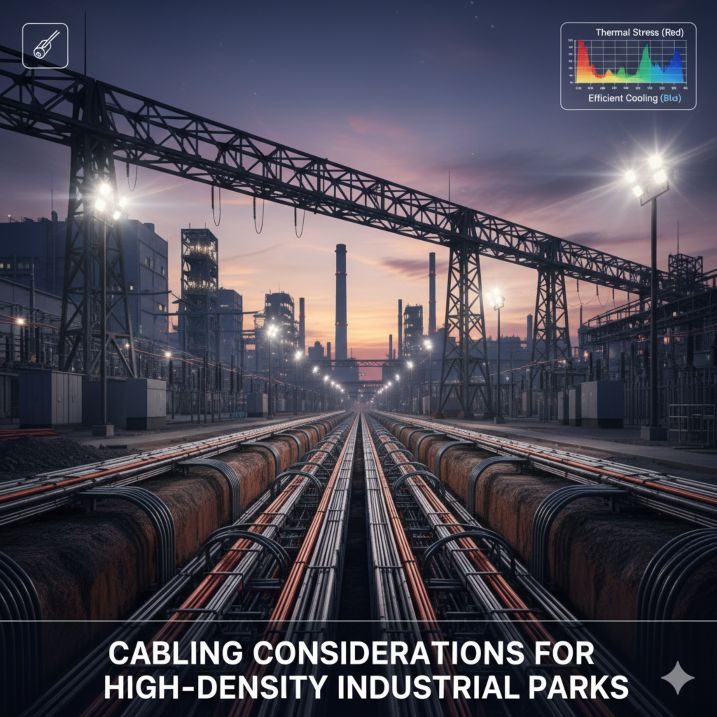
- The Thermal Bottleneck: When you run multiple high-power cables in parallel through a shared utility trench, they generate an enormous amount of heat. If they are packed too tightly, the heat gets trapped in the soil.
- The Solution: Engineers must perform complex thermal resistivity calculations. They dictate the exact spacing between cables and often use specialized thermal backfill (sand that conducts heat well) around the ducts to draw heat away from the wires, preventing the insulation from melting.
High Capacity in Tight Spaces
Industrial parks require huge amounts of bulk power, which means moving away from standard low voltage lines.
- Medium Voltage Distribution: To move massive power efficiently through the park, engineers use a Medium Voltage (MV) distribution ring (typically 11kV to 33kV). This allows them to push more power through smaller cables, saving precious underground space.
- Compact Designs: That is why leading cable manufacturers in uae produce compact, high-capacity MV cables. By using superior, high-dielectric-strength insulation like XLPE, the overall diameter of the cable is reduced, allowing more power lines to fit into existing underground pipe networks.
Chemical and Environmental Resilience
Industrial parks are not pristine environments. The ground can be contaminated with runoff from chemical plants, refineries, or heavy transport.
- Tough Outer Jackets: Cables entering individual factory plots must be armored against accidental digging (crush resistance) and feature outer sheaths made of High-Density Polyethylene (HDPE) or specialized chemical-resistant rubbers. This prevents soil contaminants from eating through the plastic and shorting out the grid.
Planning for the Peak and the Future
An industrial park’s power draw fluctuates wildly as different factories start up their heavy machinery.
- Load Balancing and Fault Tolerance: The cabling architecture is usually designed as a “ring main.” If a digger cuts a cable on the east side of the park, power can instantly be re-routed from the west side, ensuring that none of the factories suffer a blackout.
- Spare Capacity: Installing empty conduits during the initial build is the most cost-effective decision a developer can make. It allows new cables to be pulled through easily when a new factory moves into the park five years later.
Conclusion: The Arteries of Industry
The success of a high-density industrial park depends entirely on its ability to deliver uninterrupted, massive power to its tenants. By carefully managing underground heat, utilizing compact medium-voltage designs, and planning redundant ring architectures, developers ensure that the electrical arteries of the park never become the bottleneck for industrial growth.
Your Industrial Park Cabling Questions Answered (FAQs)
- Why do industrial parks use Medium Voltage (MV) instead of Low Voltage (LV) for their main grid?
Medium Voltage (like 11kV or 33kV) allows for the transmission of massive amounts of electrical power using much thinner cables than Low Voltage would require. This is essential for fitting the necessary power capacity into crowded underground utility trenches. - What happens if underground cables are laid too close together?
They will overheat. Cables generate heat when carrying power. If they are packed tightly in the ground, they bake each other. This causes the plastic insulation to degrade rapidly and can lead to a catastrophic electrical failure. - What is a “ring main” circuit in an industrial park?
A ring main is a loop of power cables that circles the industrial park, rather than a single straight line. This provides redundancy: if the cable is cut at one point, the factories can still receive power from the other direction of the loop. - Why is thermal backfill used when burying cables?
Normal soil or dry sand acts as an insulator, trapping heat around the cable. Thermal backfill is a specially engineered mixture of materials that conducts heat very well, pulling the dangerous heat away from the cable and releasing it safely into the surrounding earth. - How do you protect underground cables from chemical spills in a factory zone?
Cables in high-risk zones use specialized outer jackets, such as High-Density Polyethylene (HDPE) or lead sheaths, which are highly resistant to petrochemicals, solvents, and acidic soil conditions that would easily dissolve standard PVC.