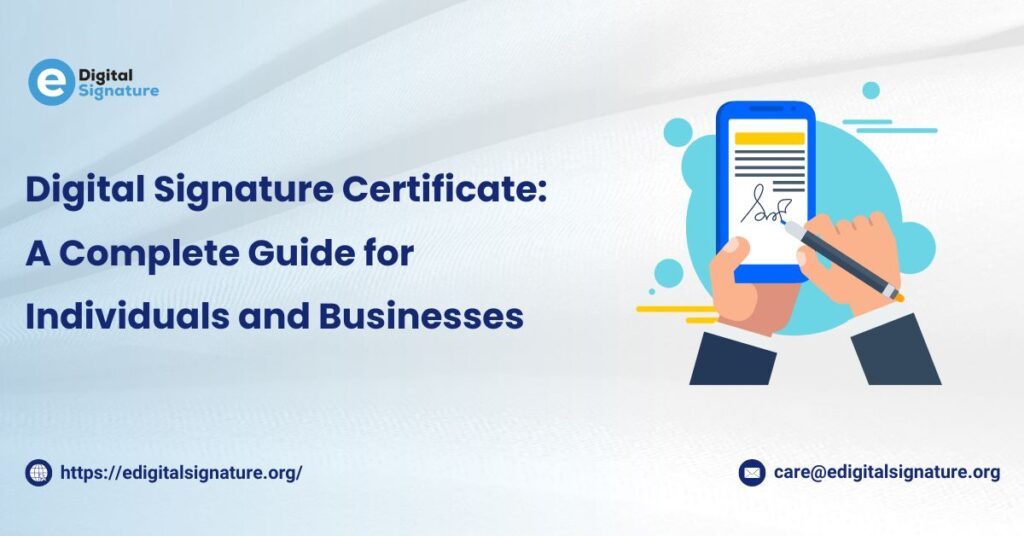
In the digital age, most business transactions, official filings, and online communications are conducted electronically. This shift has increased the need for secure and authenticated digital communications. A Digital Signature Certificate (DSC) is a crucial tool that ensures the authenticity, integrity, and non-repudiation of electronic documents. It is widely used in India and globally for e-governance, e-banking, taxation, and corporate compliance.
What is a Digital Signature Certificate (DSC)?
A Digital Signature Certificate is the digital equivalent of a handwritten signature or a stamped seal. It is used to authenticate the identity of individuals, organizations, or entities in online transactions. It works on the principles of public-key infrastructure (PKI), providing a secure way to sign and encrypt digital documents.
A DSC contains information about the certificate holder, including:
- Name of the individual or organization
- Email address
- Public key
- Validity period
- Certificate authority (CA) details
The DSC ensures that the information in the document has not been altered after signing and verifies the signer’s identity.
Importance of Digital Signature Certificates
Digital Signature Certificates have become essential for individuals and businesses for multiple reasons:
- Authentication: DSC verifies the identity of the sender, ensuring the recipient that the document or communication is genuine.
- Data Integrity: It guarantees that the document has not been tampered with after signing. Any modification invalidates the signature.
- Non-repudiation: The signer cannot deny signing the document once it is digitally signed, which is vital in legal and financial transactions.
- Legal Validity: Digital signatures are legally recognized under the Information Technology Act, 2000, in India. They hold the same validity as a handwritten signature.
- Time-Saving: Digital signatures allow faster approvals, reducing the need for physical documentation and courier delays.
- Cost-Effective: Eliminates the need for printing, scanning, and storing physical documents, reducing operational costs.
Types of Digital Signature Certificates in India
Digital Signature Certificates are classified into three main categories, depending on the usage and level of authentication:
Class 1 DSC
- Issued to individuals for basic security requirements.
- Typically used for email signing and document authentication.
- Verifies the identity of the individual against a pre-verified database.
- Suitable for users involved in low-risk transactions.
Class 2 DSC
- Required for more secure transactions such as filing income tax returns or company-related filings with the Ministry of Corporate Affairs (MCA).
- Confirms the individual’s identity against a trusted, government-verified database.
- Most commonly used by professionals, companies, and business owners.
Class 3 DSC
- Highest level of digital certification.
- Required for high-value and legally sensitive transactions like e-tendering, e-auctions, and banking transactions.
- Verification is stringent, including in-person verification of the applicant.
- Recommended for corporate executives, directors, and government officials involved in critical processes.
Who Needs a Digital Signature Certificate?
A DSC is necessary for anyone engaged in official or business transactions online that require authentication. Common users include:
- Individuals: Professionals like Chartered Accountants, Company Secretaries, Lawyers, and Income Tax Return filers.
- Businesses and Companies: Directors and authorized signatories for filing returns with MCA, e-tendering, GST registration, and import-export documentation.
- Government Officials: Employees who sign official documents, tenders, and reports digitally.
- Banks and Financial Institutions: For securing online banking transactions and digitally signing loan agreements.
- Educational Institutions: For verification of certificates, e-admissions, and administrative approvals.
How Digital Signature Certificates Work
A DSC operates on asymmetric cryptography, involving two keys: a public key and a private key.
- Private Key: Used to sign the document digitally. It is stored securely by the owner.
- Public Key: Shared with others to verify the signature. It ensures the signature is authentic and the document is unaltered.
Legal Validity of Digital Signatures in India
Digital signatures are legally recognized under Section 5 of the Information Technology Act, 2000. The IT Act provides that a digital signature is valid and equivalent to a handwritten signature or a stamp, provided it is issued by a licensed Certifying Authority (CA).
Key points about legal validity:
- DSC must be issued by a licensed Certifying Authority in India.
- Class 2 and Class 3 DSCs are commonly recognized for official and legal purposes.
- DSCs are accepted in courts and government departments for electronic filings and agreements.
Uses of Digital Signature Certificates
Digital Signature Certificates are widely used across sectors for secure, legal, and efficient digital transactions:
Filing Income Tax Returns
- Individuals, businesses, and professionals can file returns electronically using DSC for authentication.
- It eliminates the need for physical submission and allows faster processing.
Company and MCA Filings
- Directors and authorized signatories use DSC to file annual returns, incorporation forms, and other compliance documents with the Ministry of Corporate Affairs.
E-Tendering and E-Auctions
- DSC ensures secure submission and validation of bids in government and corporate tenders.
- Helps maintain transparency and legal compliance.
Banking and Financial Transactions
- Banks and financial institutions use DSC for secure online transactions, loan approvals, and agreements.
Legal Documents
- Lawyers and legal firms use DSC to sign agreements, contracts, and court documents electronically.
Educational Institutions
- For issuing certificates, marking attendance, and administrative approvals securely online.
How to Obtain a Digital Signature Certificate
Obtaining a DSC is a simple process in India. Here is a step-by-step guide:
Step 1: Visit our website
Go to our website to start the process.
Step 2: Fill in Your Details
- User Type: Choose if you are an individual or an organization.
- Certificate Type: Pick if you need it just for signing documents or for both signing and encryption.
- Validity: Choose how long you want the certificate to last.
- Personal Info: Enter your name, phone number, email, and address.
- Agree to Terms: Check the box to agree to the terms.
- Submit: Click the submit button.
Step 3: Choose Token Option
- Already Have a Token? If you have a USB token, choose “No.” If you need a new one, choose “Yes.”
Step 4: Make Payment
- Payment: Enter your payment details and choose how you want to pay (net banking, credit card, debit card, or UPI).
Step 5: Complete the Process
- Review: Make sure all your information is correct.
- Submit: Click submit and wait for a confirmation email.
Step 6: Get Your Digital Signature
You’ll receive your digital signature on a USB token drive after processing.
Tips for Secure Use of Digital Signatures
To maintain the security and reliability of your DSC:
- Never share your private key with anyone.
- Install DSC only on trusted devices.
- Use strong passwords to protect USB tokens or software certificates.
- Back up your DSC securely to prevent loss.
- Regularly update software and antivirus to prevent hacking.
Future of Digital Signatures in India
Digital Signatures are expected to become even more widespread with India’s push for digital governance. Initiatives like Digital India, e-governance, and paperless offices are increasing the demand for secure electronic transactions. DSCs will play a key role in:
- Blockchain-based transactions and smart contracts.
- E-procurement and online tendering systems.
- Secure online voting systems.
- Digitally signed certificates for education and professional qualifications.
Suggested read:- Digital Signature Certificate for Income Tax
Conclusion
A Digital Signature Certificate is no longer optional; it has become a necessity for individuals, businesses, and government bodies engaged in digital transactions. It ensures security, authenticity, and legal compliance, making online communication and transactions reliable and efficient.
Whether you are filing taxes, signing corporate documents, participating in e-tenders, or securing legal agreements, a DSC provides a trusted digital identity. By understanding its types, legal significance, and uses, individuals and businesses can leverage DSCs to save time, reduce costs, and operate securely in the digital world.
Embracing digital signatures today is a step toward a more secure, paperless, and technologically empowered future.