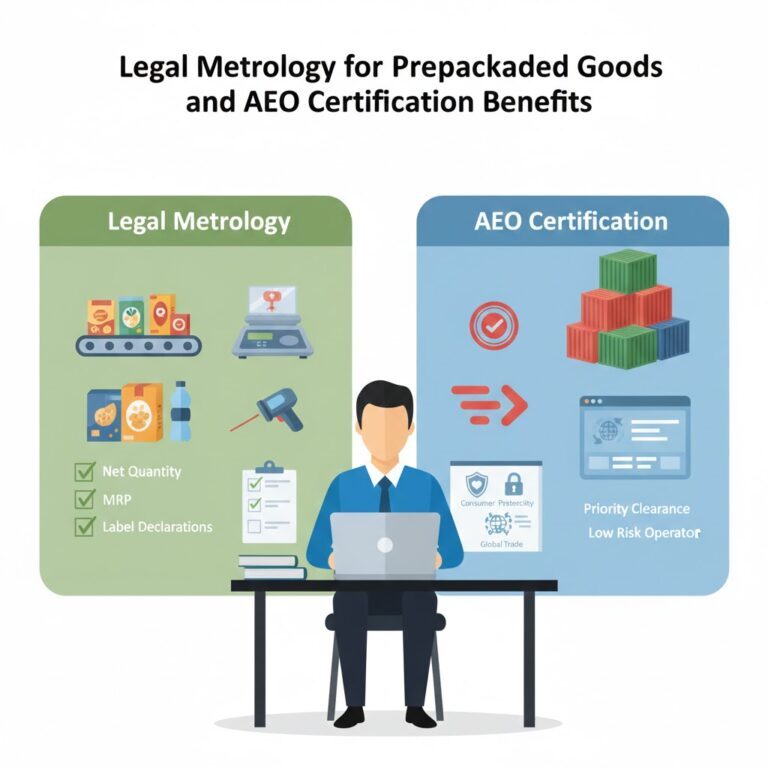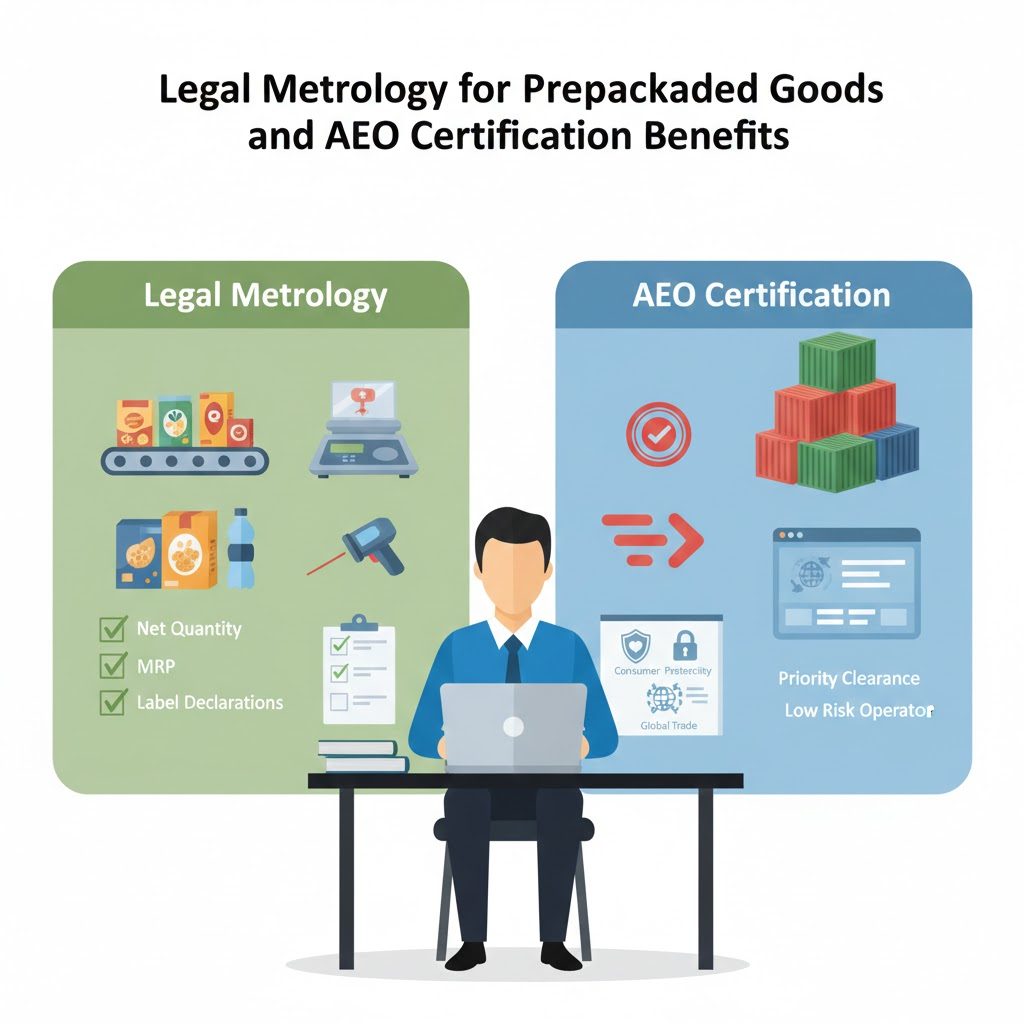
In today’s competitive and highly regulated business environment, compliance is not just a legal requirement—it is a strategic advantage. Two important regulatory frameworks that significantly impact manufacturers, importers, and exporters in India are Legal Metrology for Prepackaged Commodities and AEO Certification.
While Legal Metrology focuses on accurate labeling, packaging, and consumer protection, AEO Certification (Authorized Economic Operator) strengthens international trade operations by offering faster customs clearance and reduced compliance burdens. Together, these two systems help businesses build trust, improve efficiency, and expand globally.
This article explains both concepts in detail, their importance, practical implications, and how businesses can benefit from adopting them correctly.
Understanding Legal Metrology for Prepackaged Commodities
Legal Metrology for Prepackaged Commodities governs the labeling, declaration, and packaging standards for goods that are packed without the consumer being present. The objective is to protect consumers by ensuring transparency in quantity, price, and product details.
Under the Legal Metrology Act and Rules, every manufacturer, importer, and packer must follow strict guidelines before selling any prepackaged product in the Indian market.
Key objectives of Legal Metrology include
- Ensuring that the declared quantity matches the actual quantity inside the package, so consumers are not misled
- Standardizing labeling practices across industries to create uniformity and transparency
- Preventing unfair trade practices by enforcing accurate weight, measurement, and pricing disclosures
- Strengthening consumer trust by making product information easy to understand and verify
Mandatory declarations on prepackaged commodities
- Name and address of the manufacturer, packer, or importer
- Generic name of the commodity
- Net quantity in standard units of weight, volume, or number
- Month and year of manufacture or packing
- Maximum Retail Price (MRP), inclusive of all taxes
- Customer care contact details
Failure to comply can lead to penalties, seizure of goods, and reputational damage, making Legal Metrology compliance a critical operational priority.
What is AEO Certification and Why It Matters
AEO Certification is a flagship program introduced by the Indian Customs under the World Customs Organization framework. It recognizes businesses that demonstrate high levels of compliance, security, and reliability in international trade.
AEO-certified companies are considered low-risk operators and are rewarded with procedural benefits that simplify import-export operations.
Core benefits of AEO Certification
- Faster customs clearance through priority processing and green channel facilities
- Reduced physical inspections and document verification, saving time and costs
- Lower bank guarantees and deferred payment of duties in certain cases
- Improved credibility with global partners and foreign customs authorities
- Better risk management and smoother supply chain operations
For exporters and importers handling large volumes, AEO Certification directly impacts delivery timelines, customer satisfaction, and profitability.
How Legal Metrology and AEO Certification Work Together
At first glance, Legal Metrology for Prepackaged Commodities and AEO Certification may seem unrelated. However, in practice, they complement each other strongly.
Legal Metrology ensures that products entering the market are accurately labeled and compliant with domestic laws, while AEO Certification ensures that the movement of these goods across borders is efficient and secure.
Together, they provide:
- End-to-end compliance, from packaging and labeling to export and customs clearance
- Reduced regulatory risk, as both consumer protection and trade security are addressed
- Higher operational credibility, which builds confidence among regulators, buyers, and logistics partners
For example, an exporter of packaged food products must comply with Legal Metrology rules for labeling and weight declarations, and AEO Certification helps that same exporter clear customs faster and reduce port delays.
Who Should Prioritize These Registrations
Both frameworks are especially relevant for businesses involved in manufacturing, packaging, importing, or exporting prepackaged goods.
They are ideal for:
- Manufacturers selling consumer goods in domestic and international markets
- Importers bringing prepackaged products into India for retail distribution
- Exporters supplying packaged goods to foreign buyers
- E-commerce sellers dealing with packaged products and cross-border logistics
- Logistics and supply chain companies managing international shipments
Ignoring either compliance area can disrupt operations, cause shipment delays, or lead to heavy penalties.
Steps to Comply with Legal Metrology for Prepackaged Commodities
To comply with Legal Metrology regulations, businesses must follow a structured process.
Key steps include:
- Register under the Legal Metrology Department as a manufacturer, packer, or importer
- Design labels that meet all mandatory declaration requirements under the Rules
- Ensure all measuring instruments used for packaging are verified and stamped
- Conduct internal audits to ensure quantity and labeling accuracy
- Train staff on packaging standards and compliance documentation
Process of Obtaining AEO Certification
AEO Certification involves a detailed evaluation of the business’s compliance history, financial stability, and security standards.
The process includes:
- Submitting an online application with compliance and financial details
- Completing a self-assessment questionnaire on customs procedures and controls
- Undergoing on-site verification by customs officials, if required
- Implementing corrective measures if gaps are identified
- Receiving certification and periodic renewal based on continued compliance
AEO status is not permanent—it must be maintained through consistent regulatory discipline.
Best Practices for Long-Term Compliance
Businesses that succeed in both areas adopt a proactive compliance culture.
Recommended best practices include:
- Establishing a dedicated compliance team for packaging, labeling, and trade regulations
- Maintaining updated records of product declarations, weights, and labeling formats
- Conducting regular internal audits for Legal Metrology and customs processes
- Investing in staff training to prevent operational errors
- Engaging professional consultants to manage registrations and regulatory updates
Such practices not only prevent penalties but also improve overall business efficiency.
Conclusion:-
In a regulated and globalized marketplace, Legal Metrology for Prepackaged Commodities and AEO Certification are no longer optional—they are essential pillars of sustainable business growth.
Legal Metrology protects consumers and ensures fair trade, while AEO Certification empowers businesses to move goods faster, safer, and more reliably across borders. Together, they create a powerful compliance framework that supports trust, efficiency, and international expansion.
If your business deals with prepackaged goods or international trade, now is the time to act. Strengthen your compliance, streamline your operations, and invest in Legal Metrology compliance and AEO Certification to secure long-term success in domestic and global markets.