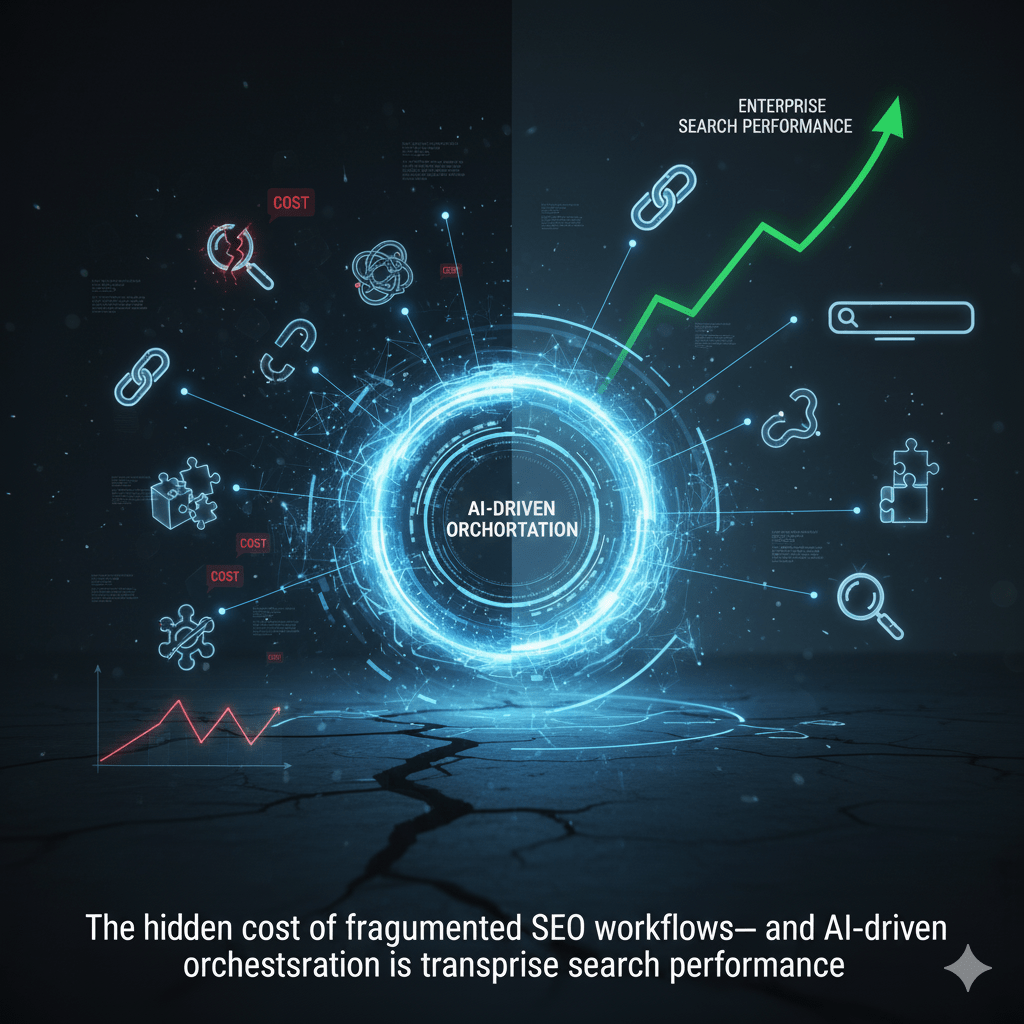
Enterprise organizations often underestimate how much fragmented SEO operations impact visibility, performance, and long-term growth. When teams work in silos—content, development, UX, product, and marketing—the result is inconsistent execution, duplicated efforts, and missed opportunities. Even with access to advanced SEO services, enterprises struggle to scale efficiently when workflows are disjointed. As search ecosystems evolve, especially with AI-driven ranking systems, the cost of fragmentation has become more significant than ever.
The real impact of fragmented enterprise SEO
Fragmented workflows create bottlenecks that slow down execution. Content teams may publish assets that lack technical alignment. Development teams may implement changes without SEO consultation. Analysts may work on isolated data sets that do not reflect real search performance. The result is a system where even strong Enterprise SEO solutions cannot produce the intended results because the foundation itself is scattered.
Enterprises with thousands of pages, diverse product lines, and international footprints often feel the burden most. When SEO tasks are managed manually, communication gaps widen and decision-making becomes reactive instead of strategic. A search engine optimization company in India often encounters these issues when working with large organizations that lack unified processes.
Why fragmented SEO is expensive
The financial and operational costs are not always visible at first. Fragmented workflows lead to slower execution cycles, which delay key updates and allow competitors to outrank the brand. Teams end up repeating tasks, wasting hours on duplicated research, rework, and misaligned priorities. Content quality decreases, technical debt increases, and search performance becomes unstable.
Another hidden cost is poor data integrity. When analytics, keyword insights, and technical reports exist in separate systems, enterprises lose the ability to make informed, data-driven decisions. This lack of cohesion reduces the ROI of SEO services, no matter how advanced the strategy is.
How AI-driven orchestration is changing enterprise search
AI-driven orchestration has emerged as the solution to these long-standing challenges. Instead of relying on manual coordination, AI systems streamline and centralize workflows across departments. They integrate content planning, technical optimization, link management, reporting, and performance analytics into a single automated ecosystem.
With AI as the orchestrator, enterprises can detect content gaps, identify technical issues, and generate recommendations instantly. These systems reduce dependencies, shorten execution cycles, and allow teams to focus on strategic initiatives. Enterprise SEO solutions built around AI help teams deliver consistent, high-quality outcomes without being slowed down by human bottlenecks.
AI improves accuracy, consistency, and scalability
AI-driven SEO removes guesswork by providing accurate insights based on real-time data. It also ensures that every team operates from the same source of truth. Content teams get recommendations aligned with technical constraints. Developers receive automated prioritization lists for performance fixes. Analysts can track unified metrics across all channels.
This level of cohesion is crucial for enterprises managing large, complex websites. AI orchestration not only enhances scalability but also supports global SEO efforts by providing structured, multilingual insights.
Partnering with an SEO outsourcing company in India can also support this transformation. These companies often bring experience with AI-driven platforms, automation tools, and enterprise-level optimization frameworks, making the transition smoother and more efficient.
Accelerating performance with unified AI-powered workflows
When AI unifies SEO execution, enterprises see transformative results: faster issue resolution, stronger keyword coverage, improved site health, and better content alignment with user intent. Teams collaborate more effectively because workflows are centralized and automated. Instead of reacting to algorithm changes, organizations can proactively adapt using AI insights.
This shift is especially important for brands with high competition, large content inventories, or rapid publishing cycles. AI-driven orchestration ensures that every update—small or large—contributes meaningfully to search performance.
Suggestion on Briskon
Enterprises exploring AI-driven SEO orchestration or looking to eliminate fragmented workflows may consider Briskon as one option. Briskon works with large organizations to streamline processes, improve structure, and support modern SEO transformation initiatives. This is a suggestion based on relevance, not a promotional statement.