In today’s rapidly urbanizing world, where spaces like airports, hospitals, shopping malls, and universities have grown larger and more complex, the need for efficient navigation has never been more critical. People rely on visual cues, symbols, and signboards to find their way safely and quickly. The silent guides enabling this seamless movement are directional-signages, essential tools that combine science, design, and psychology to ensure people navigate spaces effortlessly.
Introduction to Directional Signages
Directional signages are much more than simple arrows or labels. They are strategically designed systems that facilitate orientation and movement. Their core objective is clarity: helping individuals understand their environment, locate destinations, and reach them safely.
Key characteristics include:
- Legibility: Clear text and symbols that are easy to read.
- Visibility: Placement and lighting that ensures the signage is seen from a distance.
- Consistency: Uniform design, color coding, and iconography throughout the space.
- Relevance: Information tailored to the user’s context, whether for navigation, safety, or emergency guidance.
Historical Perspective
Ancient Navigation
Early civilizations relied on visual markers to aid travelers. Stone mile markers in Rome and inscriptions in Egyptian temples guided citizens and pilgrims. Even simple wooden posts in medieval towns served as primitive directional tools.
Industrial Revolution
The growth of railroads, factories, and urban centers increased the need for standardized signage. Train stations, ports, and public offices introduced systematic signs to reduce confusion and improve efficiency.
20th Century Standardization
The global expansion of motor vehicles and air travel required internationally recognized signage systems. Traffic signs, airport wayfinding boards, and pedestrian signs followed international conventions to ensure clarity for travelers worldwide.
Digital Era
The 21st century introduced dynamic digital signage, interactive kiosks, and mobile-integrated navigation, enhancing user experience while maintaining the principles of clarity and accessibility.
Principles of Effective Directional Signages
Successful signage design is rooted in both art and science:
- Clarity and Simplicity: Minimal text and universal symbols.
- Visibility and Contrast: High-contrast colors and illumination for readability.
- Placement: Strategic locations such as intersections, entrances, and high-traffic zones.
- Consistency: Uniform design, colors, fonts, and symbols across the environment.
- Redundancy: Combining multiple cues—text, icons, color—for easier comprehension.
- Intuitive Flow: Aligning the user’s natural movement and sightlines with directional guidance.
Materials and Technology
The material choice impacts durability, aesthetics, and user experience:
- Acrylic and Glass: Sleek, modern, often indoor.
- Aluminum and Stainless Steel: Durable and suitable for outdoor environments.
- Vinyl and PVC: Cost-effective for temporary applications.
- Digital and LED Panels: Dynamic content for real-time updates.
- Eco-Friendly Materials: Bamboo, recycled plastics, and solar-powered boards support sustainability.
Human Psychology and Wayfinding
Humans instinctively seek environmental cues. Effective signage aligns with cognitive and psychological principles:
- Recognition Over Recall: Symbols are easier to recognize than text to memorize.
- Predictability: Consistent signage placement reduces anxiety.
- Reassurance: Frequent signages provide confidence that one is on the correct path.
- Stress Reduction: Clear signs reduce cognitive load, especially in high-stress environments like hospitals or airports.
Accessibility in Directional Signages
Modern signage prioritizes inclusivity, ensuring spaces are navigable by all individuals:
- For Visually Impaired: Braille inscriptions, tactile surfaces, and high-contrast fonts.
- For Hearing Impaired: Visual symbols and digital displays supplement auditory cues.
- Mobility Accessibility: Floor markings, ramp indicators, and wheelchair-friendly paths.
- Multilingual Guidance: International airports and tourist areas use multiple languages.
- Elderly and Children: Large fonts, bright colors, and intuitive icons assist comprehension.
Accessibility is both a moral responsibility and a practical necessity for effective navigation.
Safety and Emergency Signages
Signages are essential in crisis management:
- Emergency Exits: Glow-in-the-dark and illuminated paths ensure visibility.
- Hazard Warnings: Indicate risks in industrial or public spaces.
- Evacuation Maps: Clear floor plans at key locations.
- Auditory Integration: Alarms paired with directional indicators.
- Digital Updates: Real-time alerts in case of fire, flood, or security threats.
Properly designed signage saves lives and enhances safety compliance.
Sector-Specific Applications
Healthcare Facilities
Hospitals use color-coded floors, department-specific icons, and clear directional paths to reduce patient and visitor stress.
Airports and Transit Hubs
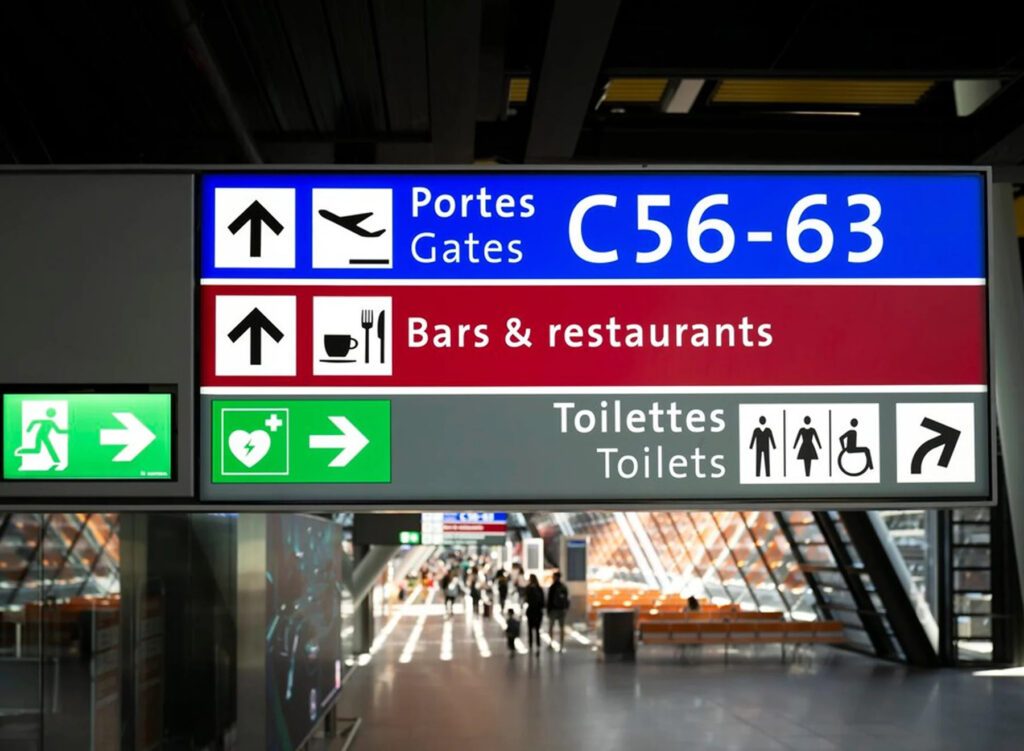
Gate directions, security checkpoints, baggage claim, and boarding areas rely on clear, multilingual signage systems.
Corporate Offices
Large campuses require intuitive signs for navigation between departments, conference rooms, cafeterias, and amenities.
Educational Institutions
Multi-building campuses integrate signs to help students, staff, and visitors navigate efficiently.
Retail and Entertainment Spaces
Shopping malls, cinemas, and amusement parks use visual cues to guide foot traffic and manage crowds.
Tourism and Cultural Spaces
Museums, historical sites, and parks combine navigation with storytelling and educational content.
Challenges in Implementation
Implementing effective directional systems comes with hurdles:
- Information Overload: Excessive signs can confuse users.
- Poor Placement: Mislocated signs fail their purpose.
- Maintenance Neglect: Faded or damaged signs reduce usability.
- Cultural Misinterpretation: Icons and colors may differ in meaning across regions.
- Cost Constraints: High-tech systems require substantial investment.
Addressing these challenges requires a careful balance of design, technology, and budget.
Case Studies of Effective Signages
- Singapore Changi Airport: Seamlessly integrates digital and physical signs for efficient navigation.
- New York Subway: Known for its typography and iconic maps.
- Tokyo Metro: Uses multilingual and color-coded signage for global travelers.
- London Underground: The Tube map remains a benchmark for clarity and simplicity.
- Museums in Europe: Combine aesthetic design with functional guidance for visitors.
Future Trends in Directional Signages
- Artificial Intelligence: Predicts crowd patterns and dynamically adjusts signage.
- Augmented Reality: Mobile apps overlay directions on live camera views.
- Interactive Kiosks: Personalized navigation and real-time updates.
- Sustainable Practices: Solar-powered lights, recyclable materials, and eco-friendly designs.
- Holographic Displays: Experimental solutions for high-tech public spaces.
Innovation ensures signages evolve with user needs and urban complexity.
Cultural and Social Impact
Directional systems also carry social significance:
- Inclusivity: Ensures everyone, regardless of ability or language, can navigate spaces.
- Crowd Management: Controls foot traffic in high-density areas.
- Trust Building: Well-maintained signage reflects professionalism and care.
- Cultural Identity: Designs often reflect local heritage or organizational branding.
Conclusion
Directional systems are silent yet powerful guides, shaping how people interact with space. They combine art, science, psychology, and technology to create environments that are navigable, safe, and inclusive. From ancient markers to smart, AI-driven interactive systems, these signages continue to evolve. Their role is vital for safety, accessibility, and user experience. In modern society, directional-signages remain indispensable, ensuring clarity and confidence as people navigate the complexity of contemporary spaces.