Personal injury lawyers deal with some of the most sensitive and high-stakes cases—accidents, workplace injuries, and medical malpractice. Every detail matters, and one missed deadline or misplaced document can affect the outcome of a case. The settlement process, in particular, is full of moving parts: medical records, negotiations, calculations, and client communication.
That’s where Personal Injury Case Management Software comes in. Instead of juggling paper files, sticky notes, and endless email threads, law firms can manage everything in one central, digital hub. According to a Clio Legal Trends Report, attorneys spend nearly 48% of their day on administrative tasks. With the right software, much of this time can be reclaimed and redirected toward clients and case strategy.
Understanding Personal Injury Case Management Software
At its core, Personal Injury Case Management Software is designed specifically for lawyers who handle injury claims. Unlike generic legal case management tools, it includes specialised modules for settlement workflows—like medical expense tracking, lien calculations, and damages breakdowns.
Key modules often include:
- Case intake systems to capture client data accurately.
- Document management to store and retrieve medical reports, police records, and correspondence.
- Settlement calculators to quickly estimate payouts and attorney fees.
- Billing and time tracking to ensure accurate invoicing.
Think of it as a legal command center tailored to the unique needs of personal injury firms.
Challenges in Personal Injury Settlement Workflows
Without software, managing settlements can feel like navigating a maze. Common challenges include:
- Manual paperwork and errors: Copying details from medical records to forms increases the risk of mistakes.
- Complex calculations: Damages, liens, and attorney fees require precision—manual math is time-consuming and error-prone.
- Tracking medical updates: Doctors’ notes, therapy sessions, and hospital bills pile up quickly.
- Collaboration gaps: Attorneys, paralegals, and clients often struggle to stay on the same page.
A Law Technology Today survey found that firms using manual methods experience 30% more delays in settlement processing compared to firms using case management software.
How Case Management Software Simplifies Settlement Workflows
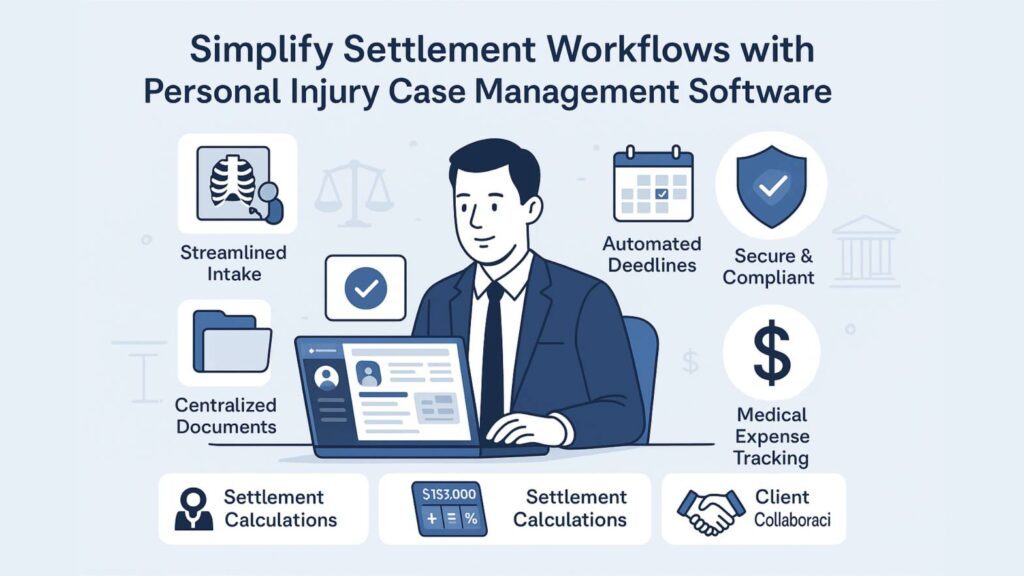
Streamlined Client & Case Intake
Forget paper forms. With digital intake, clients can submit their details online. The system then automatically checks for conflicts and adds data into the case file. This reduces errors and ensures no critical information is missed.
Example: A client injured in a car accident fills out a digital intake form, and the details instantly sync into the firm’s case management system—no double entry required.
Centralised Document Management
Instead of hunting through folders, lawyers can instantly pull up the exact record they need. AI-powered tagging and search make retrieval fast and accurate. This is especially useful in personal injury cases where evidence like X-rays, medical bills, or insurance letters are critical.
Stat: McKinsey estimates that effective document management can save professionals up to 20% of their time each week.
Automated Task & Deadline Tracking
Missed deadlines can be disastrous. The software creates automated reminders for key milestones—like discovery deadlines or negotiation dates—ensuring lawyers never miss a beat.
For example, if the statute of limitations is approaching, the system will flag it early, giving the team time to act.
Medical Records & Expense Tracking
Personal injury cases often revolve around medical records and financial damages. The software links medical records directly to cases, tracks expenses, and auto-generates summaries for settlement discussions.
Instead of manually calculating costs of surgeries, lost wages, and therapy sessions, attorneys get a ready-to-use breakdown.
Settlement Calculation & Negotiation Tools
One of the most powerful features is the built-in settlement calculator. It can instantly compute:
- Medical expenses
- Future treatment costs
- Lost wages
- Pain and suffering
- Attorney fees and liens
This allows lawyers to walk into negotiations with accurate, transparent numbers. Clients also appreciate the clarity—no surprises about what they’ll actually receive after fees.
Collaboration & Communication
Clients expect regular updates, and software makes this easier. Secure client portals let firms share documents, progress updates, and settlement offers instantly. Internally, attorneys and paralegals can collaborate in real-time, reducing miscommunication.
A LegalTech News survey found that 72% of clients prefer digital communication with their attorneys over phone calls or in-person visits.
Billing & Payment Integration
Settlement workflows often involve complex billing structures. The software tracks time, logs expenses, and generates invoices automatically. Integrated payment options make it easy for clients to pay securely online.
Security & Compliance in Settlement Workflows
Handling medical records means compliance isn’t optional. HIPAA regulations in the U.S. and other global data privacy laws require strict data handling.
Modern Personal Injury Case Management Software includes:
- End-to-end encryption
- Role-based access control (only authorised staff can view certain files)
- Multi-factor authentication
- Audit trails for compliance reporting
This ensures that sensitive client data stays safe while also keeping firms compliant with regulations.
Benefits of Using Personal Injury Case Management Software
Here’s why firms worldwide are adopting these tools:
- Saves time: Automates repetitive tasks and reduces administrative load.
- Boosts accuracy: Eliminates calculation and documentation errors.
- Improves client trust: Transparency in settlement breakdowns builds confidence.
- Increases profitability: Firms handle more cases efficiently, without burning out staff.
In fact, firms using advanced legal tech report 20–30% higher client satisfaction rates according to the 2023 LegalTech Adoption Survey.
Real-Life Use Cases & Examples
- A small firm in Texas reduced settlement processing time by 40% after implementing a case management solution.
- A mid-sized PI practice in the UK increased billable hours by 25% because automation cut down on manual tasks.
- A Canadian firm avoided a costly malpractice claim by using deadline reminders to catch a critical filing date.
Future Trends in Personal Injury Case Management
The future looks even more exciting:
- AI-driven predictive analysis: Estimating potential settlement values based on past cases.
- Blockchain: Ensuring tamper-proof settlement records.
- Voice-to-text tools: Faster documentation for busy attorneys.
- Integration with insurance platforms: Streamlined claim settlements without back-and-forth delays.
How to Choose the Right Software for Personal Injury Firms
When shopping for the right tool, consider:
- Settlement calculators and medical expense trackers
- Document management with AI search
- HIPAA or GDPR compliance features
- Billing and accounting integrations
- Cloud accessibility for remote teams
Small firms should look for user-friendly, affordable solutions, while large practices may need advanced features and scalability.
Conclusion
Personal injury cases are complex, but settlement workflows don’t have to be. By adopting Personal Injury Case Management Software, law firms can simplify everything—from intake to payout—while boosting accuracy, client trust, and overall efficiency.
In a competitive global legal market, technology isn’t just a nice-to-have; it’s the key to delivering better outcomes for clients and running a profitable practice.