Introduction
The Internet of Things (IoT) is rapidly transforming industries across the board. From manufacturing to healthcare, its influence is undeniable. However, one of the most impactful changes is happening in customer experience management (CEM). Businesses are now leveraging IoT to better understand customer behavior, personalize services, and deliver seamless interactions that drive loyalty and satisfaction.
Definition
Customer Experience Management IoT (CEM IoT) refers to the use of Internet of Things (IoT) technologies to monitor, analyze, and enhance the interactions and experiences customers have with products or services. By collecting real-time data from connected devices, businesses can gain deeper insights into customer behavior, preferences, and satisfaction, enabling more personalized, proactive, and seamless experiences throughout the customer journey.
Key Ways IoT is Transforming Customer Experience Management
Real-Time Personalization:
IoT devices generate continuous streams of data about customer behavior, preferences, and context. For example, a smart thermostat learns a user’s preferred temperature patterns, adjusting automatically to maximize comfort. Similarly, retail stores equipped with IoT sensors can track foot traffic and customer movement patterns to tailor in-store promotions.
Proactive Customer Service and Support:
Traditional customer service is often reactive — customers report issues, and companies respond. IoT shifts this paradigm by enabling proactive service. Connected devices can detect faults, maintenance needs, or usage anomalies and notify both the customer and service provider automatically.
Enhanced Omnichannel Experiences:
Customers today expect seamless experiences across channels—online, mobile, in-store, and beyond. IoT devices bridge the gap between physical and digital worlds, enabling businesses to deliver consistent and integrated experiences.
Optimized Supply Chain and Inventory Management:
IoT improves customer experience behind the scenes by optimizing supply chains and inventory management. Sensors monitor stock levels in real time, alerting retailers to replenish items before they run out. This prevents frustrating out-of-stock scenarios for customers and ensures product availability.
Benefits of IoT-Driven CXM
Enhanced Customer Loyalty:
Proactive, personalized experiences foster deeper emotional connections. Customers are more likely to remain loyal to a brand when they feel appreciated and understood.
Operational Efficiency:
Automated monitoring and predictive maintenance reduce service costs and downtime, translating into savings that can be reinvested in customer-centric initiatives.
Actionable Insights:
Rich IoT data empowers decision-makers with granular insights into product performance and user behavior, guiding product development and marketing strategies.
Competitive Differentiation:
Brands that harness IoT to delight customers stand out in crowded markets. Frictionless experiences and tailored offerings become powerful differentiators.
Challenges and Considerations
While the promise of IoT in CXM is immense, organizations must navigate several challenges:
- Data Privacy and Security:
Collecting sensitive usage data raises privacy concerns. Businesses must implement robust encryption, comply with regulations (e.g., GDPR), and maintain transparent data policies to build trust. - Interoperability:
There are various protocols and platforms in the highly fragmented IoT ecosystem. Ensuring seamless communication among devices and backend systems requires adopting open standards and investing in integration layers. - Scalability:
As the number of connected devices grows, so does the volume of data. Companies need scalable cloud architectures and advanced analytics pipelines to process and act on real-time streams. - Change Management:
Transforming CXM with IoT often entails organizational shifts. Teams must develop new skills in data science, edge computing, and cybersecurity. Collaboration across departments and clear governance are crucial.
Best Practices for Implementing IoT-Enabled CXM
- Define Clear Objectives
Start with specific customer pain points—be it reducing support calls, increasing personalization, or improving operational uptime. Align IoT initiatives with measurable business outcomes. - Prioritize User Experience
Technology for technology’s sake rarely pays off. Craft IoT solutions that seamlessly integrate into customers’ lives, offering tangible benefits without complexity. - Invest in Analytics and AI
Raw data is only as good as the insights you derive from it. Build robust analytics platforms and employ AI/ML models to detect patterns, predict behavior, and automate decision-making. - Ensure Robust Security
Adopt a “security by design” approach. Encrypt data at rest and in transit, implement device authentication, and conduct regular vulnerability assessments. - Foster Cross-Functional Collaboration
IoT projects intersect hardware engineering, software development, marketing, and customer support. Assemble multidisciplinary teams to ensure all perspectives are addressed.
The Future of IoT in Customer Experience
As 5G networks expand and edge computing matures, IoT devices will become even more intelligent and responsive. We can expect:
- Real-time AR/VR experiences powered by IoT sensors are made possible by ultra-low-latency interactions.
- Greater autonomy in devices, where edge analytics allow immediate personalization without cloud round-trips.
- Expanded ecosystems, with interoperable IoT platforms linking products, vehicles, infrastructure, and smart cities.
- Ethical AI frameworks, ensuring IoT-driven personalization respects privacy and fairness norms.
In this evolving landscape, brands that embrace IoT’s potential to deliver seamless, personalized, and proactive experiences will redefine customer expectations and build lasting loyalty.
Growth Rate of Customer Experience Management IoT Market
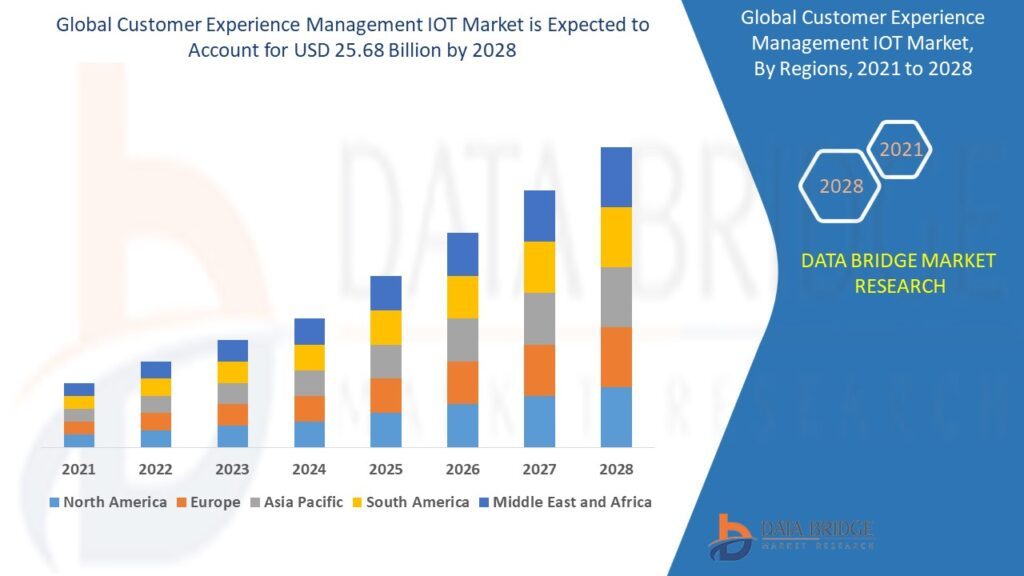
According to Data Bridge Market Research, at a compound annual growth rate (CAGR) of 19.90% from 2024 to 2031, the worldwide customer experience management IoT market is predicted to growth from its 2023 valuation of USD 10.36 billion to USD 44.25 billion by 2031.
Read More: https://www.databridgemarketresearch.com/reports/global-customer-experience-management-iot-market
Conclusion
The Internet of Things is reshaping Customer Experience Management from a reactive, channel-centric practice into a dynamic, data-driven discipline. By harnessing real-time insights, predictive intelligence, and seamless omnichannel integration, organizations can anticipate customer needs, deliver hyper-personalized interactions, and differentiate themselves in competitive markets. While challenges around security, interoperability, and change management remain, a thoughtful, customer-first approach will unlock IoT’s full potential.